CLICK HERE FOR THOUSANDS OF FREE BLOGGER TEMPLATES »

Thursday, March 6, 2008

Good News from Iraq: 6 Mar 2008

From MNF-I, Route Michigan Opens in Ramadi, Traffic Flows Again.

CAMP RAMADI — Three years ago, Route Michigan was closed for Iraqis because of all the violence in the city of Ramadi, but all that changed when Coalition forces and city officials reopened the main road during a ribbon cutting ceremony, March 2.

Gone are the concertina wires and cement barriers, which have been replaced with newly-constructed tiled medians and street lights on the main road of the city.

“The opening up of Route Michigan is an important day for Ramadi,” said Ramadi Mayor Latif Obaid Ayadah. “It will allow traffic to move easier through the city from here to other places in Iraq.”

Route Michigan is the major highway out of Baghdad that runs west through Fallujah and Ramadi, and all the way through Anbar province to the Syrian border. It’s the main supply route for commercial goods, and traveling through much of western Iraq.

“The safety of Route Michigan will be run by the Iraqi Police, who will be controlling the two checkpoints on the street,” Ayadah said. “It was closed for years because of all the violence from terrorists.”

The improved security enables the usage of the entire route for civilian traffic, which was thought to be unlikely given the road’s violent past. Iraqi Police from all districts of the city turned out to witness the grand opening.

“The city has been through a lot,” said Iraqi Police Major Adel Ahmad, from the Kurama Iraqi Police station. “This road has been closed from combat operations in the city for too long. We all worked hard to get to this point, and it’s great to see life returning to normal.”

Present for the ribbon cutting was the 1st Brigade Combat Team Commander, Col. John Charlton, whose unit helped bring stability to the city in the beginning of last year.

“Ramadi is a safe city again from the efforts of Iraqi Police, Soldiers and Coalition forces here today,” he said. “The city looks great; there’s lots of construction going on, and I’m humbled to be here and see travel through the city open for everyone.”

Ramadi was plagued by insurgents, which all but disrupted life in the capital of Iraq’s western province. Now the area along Route Michigan is a far-cry from the war torn streets of yesterday.

“When I first drove on Michigan a year ago, the streets were lined with building rubble and there was trash everywhere,” said Spc. Jamie Blasingame, Company B, 3rd Brigade Support Battalion personal security detachment.

He said the people on the road didn’t have a sense of being safe considering how bad security was in the city.

“That’s the feeling you got when you moved down the route,” Blasingame said. “There were hardly any people near the buildings that lined the route.”

The Soldiers moving through the city have seen a big change in the short time they have driven on Route Michigan. The roads have been cleaned and military convoys move with the traffic instead of stopping it completely.

“The traffic doesn’t stop for us and now Iraqis have the freedom on the road like you’d see anywhere else,” said Spc. Alaisea Yandall, also from Co. B, 3rd BSB. “I never thought I’d see such a big change in the city.”

Soldiers driving through the main street of the city can attest that if Route Michigan’s opening is any indication, Ramadi is going to see more good times ahead.
Wednesday, March 5, 2008

Capturing a moment

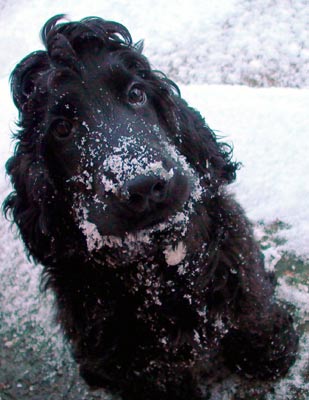
Yesterday, we got a hard snow, thunder snow, blowing snow, probably as close to a blizzard as I have ever seen. My house was in one of the heavy snow bands that came through our area. I stayed home with the doggies.

Moo, a rugged princess like me, isn't too fond of the cold. Bear, who is part Husky, loves it. So I was thinking that I would have one dog outside rolling around in the blizzard with a smile on his face, and the other dog curled up next to me in my chair.

I was quite surprised when Moo decided to follow Bear outside. The two ran around and played for a good 10 minutes. It has probably been a couple of years since I have really seen them play like that. I took advantage of moment and stood and watched them, smiling at the simpleness of it.

Note: That is not my dog in the picture.

Good News from Iraq: 5 Mar 2008

From LA Times, A Special Bond Between Soldiers In Iraq.

Minari Village, Iraq--Staff Sgt. Iron quakes with fear at the sound of explosions. He brawls with other soldiers. He whines when he doesn't get his way and slows others down when he stops to relieve himself during patrols through hostile territory.

But nobody complains, because when it's time to enter a building that might be rigged to explode, or cross a pasture that could conceal a minefield, Iron is at the front of the line, making sure it's safe for those who follow.

If it's not, Iron will bear the brunt of the blast, along with his best
friend, Sgt. Joshua T. Rose, who ranks one level below him. It's an honor Iron enjoys for the dangerous job he does. It also ensures that charges could be filed against Rose in the unlikely event he ever mistreated Iron -- an 80-pound German shepherd.

Rose and Iron are one of about 200 canine teams deployed in Iraq, where the bond between soldiers and their dogs is so deep that some handlers have asked to be buried with their canine partners if they are killed together.

On frigid winter nights in the Iraqi desert, Rose shares his cot and
sometimes his sleeping bag with Iron to keep him warm. In the scorching summer heat, he makes sure Iron has enough water before taking his own share. If the heat is too much for Iron, who has a thick coat of glossy black fur, Rose lets him rest, no matter what the platoon leader might want.

Whenever he goes on a mission, Rose tucks a copy of an ode to police and
military dogs into his front pocket. It reads in part: "Trust in me, my friend, for I am your comrade. I will protect you with my last breath. When all others have left you and the loneliness of the night closes in, I will be at your side."

"These dogs are like our children. I'm closer to my dog than I am to
anyone other than my wife," said Staff Sgt. Charles W. Graves, the kennel master at Forward Operating Base Kalsu, about 20 miles southeast of Baghdad.

Graves works with Udo, a yellow Labrador retriever who holds the rank of sergeant 1st class, one higher than Graves. He is the fifth dog Graves has been teamed with.

Graves adopted his first dog after it retired from active duty. The dog died at age 16, from a heart attack while chasing a cat.

His fourth dog was aggressive and liked to bite, nothing like Udo, who is a specialized search dog. That means he isn't aggressive and can run off his leash, wearing a vest that holds a radio through which Graves issues commands.

"If something ever happened to him, I'd never work canine again," Graves said as Udo did a practice run across a field dotted with remnants of once-lethal explosives and other weapons.

Handlers are expected to keep their dogs "on odor" by putting them
through such training every month, to ensure they don't lose the ability to detect TNT, C4, AK-47s, wires, metal and the other threats that insurgents have planted across Iraq.

"If they took him out, I'd kinda wish they'd take me out too," Graves, a former police officer from Oroville, Calif., said as Udo loped nearby. With each successful find, Udo was rewarded with a toss of his favorite toy, a rubber cone.

"It's a helluva thing, owing your life to a dog," Graves said.

Before each deployment, troops are asked to update their wills. Graves
included a request to be buried with Udo should they die together. It has happened before. Last July, Cpl. Kory D. Wiens, 20, and his Labrador retriever, Cooper, became the first soldier-dog team killed since Vietnam. They were buried side by side in Wiens' hometown of Dallas, Ore.

If you spend time with the soldier-dog teams, it becomes clear that the
key to being a successful canine handler is to love dogs and to adapt to their childlike needs.

"If you deal well with kids, you'll deal well with dogs," said Rose, who has a husky and a dachshund back home in Kansas. "You're working with about a 3-year-old mentality."

Navy Petty Officer 2nd Class Blake T. Soller knows that all too well. Last April, his 4-year-old dog, Pluto, couldn't resist leaping over the side of a cargo ship into New York Harbor, 60 feet below. Soller jumped in after Pluto and stayed with the 87-pound Belgian Malinois until a Navy boat picked them up. Neither was injured.

The U.S. military has used dogs in combat zones since World War II and deployed about 4,300 to Vietnam between 1965 and 1973.

According to the military, 281 died in the line of duty there, but
hundreds more died after the war ended and U.S. troops departed. Back then, there were no provisions for military dogs to be adopted when their careers were over. Most were euthanized or left behind to uncertain fates.

That changed in 2000, with a law allowing retired military dogs to be
put up for adoption at the Military Working Dog center at Lackland Air Force Base in Texas. They range from small breeds such as beagles to hulking hounds.

Since the start of the Iraq war, about 1,000 dogs have passed through
the combat zone, and three, including Cooper, have been killed in action.

Handlers say dogs are crucial for sniffing out the roadside bombs that
are responsible for most soldier casualties, and for smelling wires that indicate booby-trapped buildings. They also search for drugs and illegal weapons at border crossings and checkpoints, chase down suspected insurgents and hunt for human remains.

And for the first time, the military has sent dogs into a war zone to serve as therapy for troops. Last month, two black Labradors arrived in Iraq to work with stressed-out soldiers.

A canine doesn't have to be a therapy dog to be therapeutic, though.

On a chilly winter's day, as troops prepared for a mission in southern
Arab Jabour, southeast of Baghdad, attention was focused on Pluto and Iron, not on the dangers ahead. Rose scratched Iron's ears. Pluto stood on his hind legs and leaned into Soller's chest, like a dance partner. Other soldiers stood around in full battle gear, talking about their own dogs back home.

Until several weeks ago, the region was in the hands of Sunni Muslim
extremists loyal to Al Qaeda in Iraq. A U.S. bombing campaign drove many of them out, but they left behind roads and buildings laden with explosives, and orchards littered with buried ordnance and weapons.

"I've had people say, 'It's a good thing you're in the Navy, because
that means you're not on the front lines,' " said Soller as he and Pluto led the way down an eerily quiet dirt road lined with houses tucked back among high grass and fruit trees. "It doesn't get any more front line than this. My job is to clear the way so the rest of the guys can get there."

Soller, who used to train hunting dogs in Indiana, was tapped to attend
canine handling school as a reward for exemplary service in the Navy. Rose, whose father was a police canine handler back home in Virginia, asked to attend the school after earning high marks from a platoon sergeant.

The biggest mistake handlers make is being impatient, Rose said as Iron
veered to the side of the road and lifted his leg. The rest of the patrol slowed to avoid getting ahead of the canine team.

Visits to two homes, including a lavish villa overlooking the reedy
banks of the Tigris River, showed how having dogs in the mix can alter an otherwise tense situation.

A grinning adolescent boy used hand signals and broken English to
jokingly offer a trade: lean, amber-eyed Pluto for one of his sheep, which stood in a silent, fluffy flock staring at the dogs. In the garden, two women presented the troops with pizza-sized slabs of hot, freshly baked flatbread. Then the boy explained through an interpreter that there were weapons stashed in the wooded area across the road.

Soon, Rose and Iron and Soller and Pluto were pushing through a dense thicket. Within minutes, Rose spotted a subtle change in Iron's behavior as he nosed around some palm fronds. The 7-year-old dog calmly sat down, a sign he had found something. A metal detector and shovel proved him right. A pipe bomb wrapped in a green sack was buried in the dirt.

By the end of the mission, Iron had made a second find.


After each discovery, Rose rewarded Iron with tosses of a red rubber
cone -- as with Udo, Iron's favorite treat.

The dogs are bought from breeders in Europe and the United States and then trained at the military's dog school at Lackland Air Force Base.

Iron washed out of two training courses, and his future in the military
looked bleak until Rose met him in December 2005.

Rose determined that the problem was not Iron's nose. It was the fake
rawhide bone being used as his reward. It wasn't appetizing enough to make the dog work hard. When Rose tried the rubber cone, Iron began picking up scents.

Each dog is different. Pluto's favorite toy is attached to a rope, because he likes playing tug of war with Soller. The petty officer remembers one dog who was satisfied only with a toy steak that squeaked when bitten.

Should dogs be wounded or fall ill, they are given immediate care.
Handlers are trained to provide basic treatment until the dog can be taken to a military veterinarian.

When Iron broke a canine, a critical tooth for a dog who sometimes must chase down suspects and hold them, he was given a root canal to save the tooth the same day.

Severe cases are flown to Germany. This happened with Rose's last dog, Rex. In 2005, Rose and Rex were providing security at the Baghdad trial of former Iraqi leader Saddam Hussein. One day, Rex wouldn't eat. Rose knew that when his 105-pound German shepherd didn't eat, something was wrong.

He had him checked by a military veterinarian in Baghdad. The diagnosis
was cancer. Rex was dying. He was flown to Germany and euthanized.

But Rex's memory lives on at Ft. Riley, Kan., home to the Army's 1st
Infantry Division and Rose's home base. At the base, dogs have a place to play. It's called Rex's Bark Park.

Tuesday, March 4, 2008

Opening my eyes

Within the last month, I've spotted two very large tractor-trailers proudly designed for the Marines. The first time I saw one, I teared up with pride. I haven't been able to figure out what they are for. The one at the right here is not exactly like the ones I've seen, but you get the idea. A couple more pics can be found here.

Lately I've been noticing a lot more Army and Marine stickers on cars. I am sure they have been there all along, Maybe I couldn't see them before. Perhaps they didn't fit with my perspective that most people in this area don't support the military, aren't affected by the war, and/or don't care.

Whatever my thinking was, it is obviously changing. I think all it really took was opening my eyes without expectation for what I would see.

Good News from Iraq: 4 Mar 2008

From MNF-I, Youth Sports Club Opens, Child Athletes have Place to Compete.

SULEIKH — As security improves in this Baghdad neighborhood, Iraqi citizens are focusing more attention on the quality of life in their community.

Several Suleikh area residents and leaders, Iraqi Army and Multi-National Division – Baghdad Soldiers attended the grand opening celebration of the Suleikh Club, a youth sports center, March 1.

A procession of area athletic teams, including soccer, basketball, wrestling and martial arts groups, opened the festivities. The different squads marched in, proudly displaying colorful uniforms and team signs. The center will provide a place to practice and compete in their individual athletic disciplines.

Several community leaders including Fikrat Kareem, the neighborhood advisory council leader for the area, and Iraqi Army Lt. Col. Yeheya Rasol, commander of the 3rd Battalion, 1st Brigade, 11th Iraqi Army Division, spoke during the event.

“The opening of the club was beautiful,” Fikrat said through an interpreter. “Many citizens came to the (event). They are excited. Life is returning to normal.”

The club, which was originally built in 1957, is again a place where young people can participate in different sports, said Lt. Col. Wilson Shoffner, the commander of the 2nd Battalion, 319th Airborne Field Artillery Regiment, 2nd Brigade Combat Team, 82nd Airborne Division, currently attached to 3rd Brigade Combat Team, 4th Infantry Division, MND-B.

The club was shut down in 2005 due to criminal activity in the area.

“We had a couple of different insurgent groups operating here, some of them actually using the Suleikh Club as a base of operations. Obviously, with insurgents operating out of the club, that drove away the reason for its existence,” said Shoffner, a Lawton, Okla., native.

As the Iraqi Army and the local security forces in the area began to work together with Coalition forces, the area’s safety improved.

“The Iraqi Army and Sons of Iraq work together now,” said Yeheya. “We do our duty together to kick all of the terrorists out of Suleikh for the future (of the community).”

The Iraqi Army, the Suleikh neighborhood council and Coalition forces have been working to renovate the club during the last five months, said Shoffner.

The increased safety encouraged area leaders to focus more on reconciliation efforts.

“This club is the beginning of reunification in the area,” said Fikrat.

The youth sports center will connect several different neighborhoods in the area including Rabee’a, Suleikh, Tunnis, Shababkur and Qahira, he added. The youth sports activities bring the different groups in the area together for a common cause.

As reconciliation efforts continue, community centers, such as the Suleikh Club, will have a lasting impact on the Iraqi citizens.

“It was appreciated by the people here,” said Shoffner. “I think it will continue, long after the Coalition forces are gone, to be a place where people come to focus on youth sports center activities.”

Monday, March 3, 2008

Another month

And then it was March.

Another month is behind us. Deployment is another month closer to being finished.

This last month we paid off a credit card, paid off the car, had an anniversary, gained clarity and certainty for our next move, met big deadlines, and made some good contributions; nearly sliced off a thick flap on my thumb, got stitches, saw more doctors in a month than I can ever recall. Time to exhale.

But once again, I seem to have gotten all caught up in the other stuff that is life and have not focused on the internal me. Getting back in balance, even if it is just for 5 seconds, is what this month is going to be about.

So instead of making a mental list of the things I need to outside, I think I'll make an internal to do list, the things I can (not should do) to be kind to myself, to reward myself for all the hard work I do. Things like reading that feeds my spirit. Getting a massage. Getting a pedicure. Taking a nap. Just do nothing. Catch up on blogs. Go for a walk. Forgive myself. Go where the wind takes me. Get lost and found.

A little something most days will go really far, I think.

Good News from Iraq: 3 Mar 2008

From MNF-I, Soldiers Offer Micro-Grants to Struggling Store Owners in Husseiniya.

HUSSEINIYA — As the door opened, the shop owner momentarily halted his conversation with the unexpected visitor to tend to the needs of a customer who walked into his dimly lit store, Feb. 26.

After the customer left the store with his purchases, the vendor proceeded to tell the visitor, 1st Lt. Otis Ingram, that he did not need monetary aid for his business, as it was doing well; the businessman did, however, inform Ingram of businesses a few blocks down that needed the micro-grants that were available.

Upon leaving his initial stop, Ingram, a Colorado Springs, Colo., native, who serves as the platoon leader for 3rd Platoon, Company B, 1st Combined Arms Battalion, 68th Armor Regiment, 3rd Brigade Combat Team, 4th Infantry Division, Multi-National Division – Baghdad, went with his platoon to the area the shop owner directed them.

During their day-long venture, the Soldiers visited several small businesses in Husseiniya to assess their needs for monetary aid in the form of U.S. Army and government of Iraq funded micro-grants.

“We know this operational area and the people in it, so we can find out who needs the money,” said Sgt. Luke Groeninger, a Colorado Springs, Colo., native, who serves as squad leader with 3rd Pltn., Co. B.

The micro-grants offered must be used to improve the business. They are a one-time grant designed to boost the business’ productivity. With the grants requested often being much smaller than the $2,500 maximum amount – approximately $400 – the Soldiers can offer the aid to several businesses in the area, said Ingram.

“We’re giving them a grant that [will] make their business better so that [the community] is more economically stable,” he explained.

The money requested can be used for a variety of purposes. The owners are frequently looking for money for small, low-cost improvements.

“All of [the ‘mom-and-pop’ corner shops] want new paint,” said Ingram. “They want new racks for their groceries. Sometimes, they want a new refrigerator. A lot of [the refrigerators here] are really old.”

During the mission, two shop owners the Soldiers visited applied for micro-grants on the spot.

“We helped them fill out the paperwork and submitted the request for approval,” Groeninger said.

Sometimes, store owners choose not to accept the help. They do so for a variety of reasons.

“Some of [the business owners] won’t take [the micro-grants] because they feel that they’re really not that poor – they’re really not that bad off,” said Ingram. “Their business is doing pretty [well], and they know hundreds of other businesses or people who have it way worse than they do.”

While unexpected, the refusal of some to accept the grants indicates the residents are proud of their hard work and want to be successful on their own. They are also using the program correctly.

“[It’s] kind of refreshing … because you see people who are actually hoping that the help goes to those who need it,” Ingram added. “It’s also eye opening. You think everybody just wants a handout – and sometimes they don’t.”

Like the man at the first stop, those who do not want the grants often guide the Soldiers to those who do need them.

After they arrived at the stores they were told about at their first stop, Ingram and his Soldiers helped two different shop owners apply for the grant.

Sunday, March 2, 2008

Coffee for the CTU Gang

I sent off another care package to Jack Bauer and the CTU Gang yesterday. It should be one of the last ones I send. Really, I got to think that our time is beginning to wind down. Maybe I'll send them a ton of coffee just before Jack leaves so the Gang that remains behind isn't left completely without. Oh sure, I could continue to send them stuff, but chances are I won't. I've been extremely generous already.

Anyway, here is what I sent in this last package.


  • Trader Joe's Handful of Almonds. These are individual packs of almonds; great for throwing in the pocket.
  • Trader Joe's Dried Mango

  • Trader Joe's Dried Dragon Fruit. I really have no idea what this fruit tastes like. It just sounds good. :D

  • Surf Sweets Organic Jelly Beans. Maybe they will arrive in time for Easter and Jack can make sure someone with a sweet tooth gets them.

  • Surf Sweets Organic Fruit Bears

More cards


Sent out 15 cards to Soldiers' Angels Germany for our wounded soldiers.

Running total: 828

Good News from Iraq: 2 Mar 2008

From MNF-I, Sewing School Offers Iraqi Women Skill, Employment Opportunities.

FOB RUSTAMIYAH — Sowing seeds of economic opportunity and prosperity, a vocational technical sewing shop for Iraqi women opened its doors Feb. 23, offering classes at Zafaraniyah Technical Institute.

The grand opening of the sewing school paves the way for about 100 Iraqi women in Zafaraniyah seeking employment. In addition to offering steady work, the school offers students a skill they can use elsewhere in the future, commented Capt. Kevin Dagon, a Butler, Ill., native, who serves as a fire support officer with 5th Battalion, 25th Field Artillery, 4th Brigade Combat Team, 10th Mountain Division (Light), Multi-National Division-Baghdad.

“It is very good that we found this job today,” said Antisar, a sewing student and widow with four sons.

Antisar attested to the importance of her sewing job and expressed pride in having an opportunity to begin a new trade to help support her family. Like many mothers, Antisar said she is trying to provide for the future of her children. One of Antisar’s sons is in medical school and another is studying to become an engineer, she explained.

The sewing shop project helps widows and women with displaced families find work, explained Madeeha Hasan, a council member of the Karada Political District. Putting together the project was difficult, said Hasan, who was in charge of coordinating and planning the sewing shop project. It wasn’t easy to find space for the workshop, she said.

While opening the sewing shop is a small step in the overall effort in Iraq, it is still a very big achievement, Hasan believes.

Saturday, March 1, 2008

Help wanted ad answered

So not too long ago, I was seeking Clarity and Certainty. Some of it has arrived. Things are starting to fall into place. Our plans for when Jack Bauer comes home are beginning to solidify. It is all very exciting.

First up. I need start getting this house ready to sell in a few months. Oh boy. Lots of work to do.

The plan is for me and the doggies to go with Jack to school for 10 weeks. I need to figure out what to take to make a Residence Inn feel like home during that time. Just a few homey touches.

I've got my work cut out for me. But my parents are going to come help a bit and Jack should be home for sometime before school starts. I'll just do the best I can with what I've got. Right?

Good News from Iraq: 1 Mar 2008

From MNF-I, Veterinarian Clinic Treats 300 Sheep in Rural Iraqi Community.

BAGHDAD — With the help from civil affairs veterinarians, Multi-National Division – Baghdad Soldiers from 1st Battalion, 320th Field Artillery Regiment, 2nd Brigade Combat Team, 101st Airborne Division (Air Assault), held a veterinarian operation Feb. 22 in the southern portion of Abu Ghraib in the Iraqi capital.

The sounds of sheep echoed through the air as they arrived in herds of nearly 30 at a time to this very rural area of Baghdad. Surrounded by orange fencing, sheep waited to receive vaccination shots to help with their growth and reproduction issues.

The purpose of the vet operation, in which approximately 300 sheep were treated, was to help the local populace with their livestock, making them healthier and able to reproduce to better the local economy, said Staff Sgt. Richard Gilliland, Huntsville, Ala., native, and civil affairs non-commissioned officer in charge with 1st Bn., 320th FA Regt.

The community’s residents told the Soldiers that their livestock were not doing very well when it came to their growth and reproduction, he said. Platoon leaders and battery commanders pushed out into the community to tell the local sheiks and residents to bring their sheep to the event.

“What I hope to happen is the animals, first off, all get better and are able to reproduce for these farmers,” he said. “Then, that way they can have a better herd for future meals and make them more economically healthy.”

It’s not a huge concern thus far within the area, but given the fact the sheep are the Iraqi’s main source of food in this area, this needed to be done, Gilliland said.

Air Force Staff Sgt. Billy Nored, a Murray, Ky., native, with the 492nd Civil Affairs Battalion, injected the sheep with ivormectin, which was used as a de-wormer to get rid of the screw flies plaguing the sheep.

“Screw flies manifest themselves in, and host themselves on, sheep and start to produce infection,” Nored said. “We are doing all we can to improve the quality of livestock for the local populace.”

“We can make the quality of the animal better,” added Capt. Zach Mills, a Golden, Colo., native, who serves the 432nd Civil Affairs Battalion. He also injected the livestock with Clostridium Chauvoei & Clostridium Septicum.

“For the economy,” said Mills, “it will allow for better meat and better quality. It will allow for the economy to grow from the ground up.”

While injecting the sheep with vaccine, the team was also trying to get a general consensus of what the animal’s conditions were in the past and what their current conditions are, said Nored.

“The quality is not bad; it’s actually pretty good,” he said. “It’s good that the word got around, so these animals could get vaccinated. It’s going to help.”

Another problem they are facing in the area is the lack of an Iraqi veterinarian clinic to treat these animals, said Gilliland. The Top Gun troops want to identify a qualified vet, provide him with a traveling veterinarian kit, and allow him to move through the community to give the animals regular immunizations and examinations.

“The ultimate goal is to get a veterinarian in this area to try and help these people with their animals,” Gilliland said. As Coalition forces continue to move more toward an overwatch position, allowing Iraqis to take care of Iraqis is essential. So getting a veterinarian into the area allows Coalition forces to continue that move toward overwatch.

“We are trying to stimulate their economy as we continue this push forward,” Mills said. “We want them to be able to do this themselves.”

In four weeks the veterinarians will come back to the community to assess the improvements of the sheep.

Friday, February 29, 2008

Ahhhhhhhh


The week is over.

The big deadline was met.

Now, time to relax? Ha!

Time to call the real estate agent, again.

More later on that. :D

Tuesday, February 26, 2008

Cards


I sent 25 cards to SAG yesterday.

Running total: 813

And just another nice picture. :D

Monday, February 25, 2008

The Week of Insanity

I've got a big deadline on Friday. I think I might be running around crazy-like between now and then.

In an effort to ease this week's activities, I am giving myself permission to drop off the radar screen here.

I feel like I need to explain this to myself.

BW, it will be OK.

And I need to not argue with myself about it.

See you all later.

Good News from Iraq: 25 Feb 2004

From MNF-I, IED, Indirect Fire Cells Disrupted by Weapons Find.

PATROL BASE LUTIFIYAH — A significant weapon cache was discovered through a group effort between Iraqi Army and U.S. Soldiers Feb. 19, north of Lutifiyah.

Led to the site by a tip from a local citizen, members of 1st Battalion, 4th Brigade, 6th Iraqi Army (IA) division and 4th Platoon, Battery B, 3rd Battalion, 320th Field Artillery, 3rd Brigade Combat Team, 101st Airborne Division (Air Assault), found a mass of weapons and homemade explosives.

The cache contained various improvised explosive device (IED)-making materials, multiple explosive rounds, firearms and documentation.

“The source of intelligence for the cache was with us the whole way,” said Capt. Charlie Lewis, executive officer for Btry. B, 3-320th FA. “He led us to the location and told us the cache was located between two specific houses; from there we started our search.”

The IA came upon the cache before the U.S. forces did.

“The Iraqis know the area better than us and can tell more when ground in an area has been disturbed,” said Sgt. Jeremiah Hash, fire support noncommissioned officer, 4th Plt., Btry. B, 3-320th FA.

This was the largest find for the battery since arriving in country in October.

“The find is extremely significant, we thought it was going to just be a regular cache,” Lewis said. “Instead we found a fair amount of IED-making materials, disrupting an IED cell in the area.”

Six men thought to be tied to the cache were detained and brought in for questioning.

Hash said he has seen a lot of IEDs and is confident this find will result in less attacks in the area.

Hash said mortar rounds and multiple direct-fire weapon systems found indicate an indirect fire cell was also disrupted.

Sunday, February 24, 2008

On becoming a Military Spouse: UPDATED

UPDATE at bottom.

I just got my first issue of Military Spouse Magazine. Review: not bad, actually. Looks like a good variety of material to get people started learning or updated on topics. At 66 pages, it is not comprehensive or in-depth. But I think it is going to be something I'm glad I spent money on. If nothing else, it is just one more way to feel connected to this community. And that is a good thing.

I subscribed figuring I need to learn more about what it means to be a military spouse. Yeah, yeah, I know what you all are saying. But really, outside of deployment and doing my best to support my husband, I don't know the first thing about the military or military life.

On top of that, Jack Bauer just told me that when he goes to school (which will be the first military experience for many if not most of the students), other spouses will probably look to me for answers on military life. Yikes!

So where is that Milspouse Handbook that I was supposed to have been issued? I might have to write it myself.

Chapter 1; Hurry Up and Wait. Seriously.
Chapter 2: Savoring Time with your Spouse.
Chapter 3: Don't Panic. You are really not alone.
Chapter 4: Acronyms 101. Probably needs to have a pull out card that can fit in the wallet and easily and discreetly referenced.
Chapter 5: The Big "D": Deployment
and on and on.

I am sure others have addressed these before. So if you know of someone who has prepared a simple, comprehensive, panicky-wife ready, funny, purse-sized version, please point me in the direction of it.

UPDATE 2/24/08 0732
A very nice reader e-mailed me a few suggestions and comments.

The Wows are my comments. I ordered the first one. I'll let you know what I think of it.

Good News from Iraq: 24 Feb 2008

From The Long War Journal, Gordon Alanko (aka Teflon Don of Acute Politics), In Pictures: A medical mission in Sayafiyah.

On Feb. 16, the Sayafiyah Combined Medical Engagement clinic was set up in a school occupied by Apache troop of the 5th Squadron of the 7th Cavalry Regiment, 1st Brigade Combat Team, 3rd Infantry Division, the 5/7 Cav. There is currently no doctor for the towns of Sayafiyah and nearby Al Sur. The two towns combined total about 15,000 people, most of whom have not seen a doctor since al Qaeda gained control of the area.

The CME was set up as an outreach program to provide needed medical care and help establish Coalition forces as an agent of goodwill amongst the people in Sayafiyah and Al Sur. The 5/7 Cav has conducted numerous CMEs during its time in Iraq, which helped the CME in Sayafiyah to come together smoothly.

The 5/7 Cav brought in an Iraqi doctor and two Arabic-speaking nurses, as well as a number of Army medics. They examined more than 550 people, and gave all of them hygiene supplies like soap and shampoo, vitamins for the youngsters, and prescriptions as needed for actual medical problems.

There were a few people with serious medical problems -- one woman with cancer, a boy with a broken leg -- and quite a few elderly patients. Many of the women had three to five children with them. What makes that remarkable is that many of them were not their own children. From talking to the villagers coming through the clinic, I estimated that upwards of 50 children who came through were orphans, either in actual fact, or because their parents had fled the area and left them with neighbors.

The CME mission was a resounding success: the doctor had to shut down a few hours early because the village response had been greater than anticipated. The gate guards let in a last few patiently waiting in line, and the rest were told they would be helped in a follow-up CME as soon as more supplies came in.

Soon, there will be similar gatherings with dentists and veterinarians. Sayafiyah is a brand-new rebuilding enterprise, and 5/7 Cav is at the forefront.


Saturday, February 23, 2008

Good News from Iraq: 23 Feb 2008

From MNF-I, Iraqi, Coalition security forces detain 27, discover 4 caches in recent operations in Mosul.

MOSUL, Iraq – Iraqi Army and Coalition Forces detained 27 suspects and discovered four weapons caches in the Ninewa Province in recent joint operations.

During these operations joint forces also rescued a hostage from an underground prison. These operations are part of Multi-National Division – North’s continuing pursuit of criminals in the area.

“Now is the time for everyone, ISF, Coalition Forces and the people of Mosul to stand together in a united front against these monsters in order to end their wave of violence against the innocent,” said Maj. Daniel J. Meyers, spokesman for Task Force Iron.

Friday, February 22, 2008

Good News from Iraq: 22 Feb 2008

From MNF-I, Sons of Iraq tip lead to weapons cache in Jabr al Ansari.

FORWARD OPERATING BASE HAMMER, Iraq – Acting on information provided by the Sons of Iraq, soldiers assigned to Troop C, 3rd Squadron, 1st Cavalry Regiment, confiscated a weapons cache in Jabr al Ansari, a small village southeast of Baghdad, Feb. 19.

The cache contained 21 122mm Russian projectiles and three 130mm Russian projectiles. The munitions were buried approximately three feet deep in a suspect’s backyardt. The suspect was detained and brought back to Combat Outpost Cashe for questioning.

“Every time the Sons of Iraq bring in or lead us to ordnance, it saves the lives of innocent Iraqis, as well as the lives of Iraqi and Coalition forces,” said Command Sgt. Maj. Dan Huell, from Miami, command sergeant major of 3-1st Cav. Regt. “This act signifies that most Iraqis have rejected violence and are on the side of peace.”

Lt. Col. John Kolasheski, from Louden, Tenn., commander of 3-1 Cav. Regt., believes his troops’ effectiveness operating in the Jisr Diyala area is due to the rapport developed with their Iraqi neighbors.

“This cache find serves as another example of how our soldiers are winning the trust and confidence of the population,” Kolasheski said. “By denying terrorists the use of these dangerous munitions, we collectively make Jisr Diyala and the surrounding areas a safer place for the people of the region. The Sons of Iraq continue to show their effectiveness in thickening our lines.”

The SOI have played a significant role in most of 3-1 Cav. Regt.’s recent cache finds by providing information.

“The Sons of Iraq continue to demonstrate the effectiveness of local security by decreasing accelerants and extremist activities in our area of operations,” said 1st Lt. Jamel Reese, a platoon leader in Headquarters Troop, 3-1 Cav. Regt.

The cache was destroyed by the 789th Ordnance Company, from Ft. Benning, Ga., currently attached to the 3rd Heavy Brigade Combat Team.

The 3-1 Cav. Regt. is assigned to the 3rd HBCT, 3rd Infantry Division, from Fort Benning, Ga., and has been deployed in support of Operation Iraqi Freedom since March.